
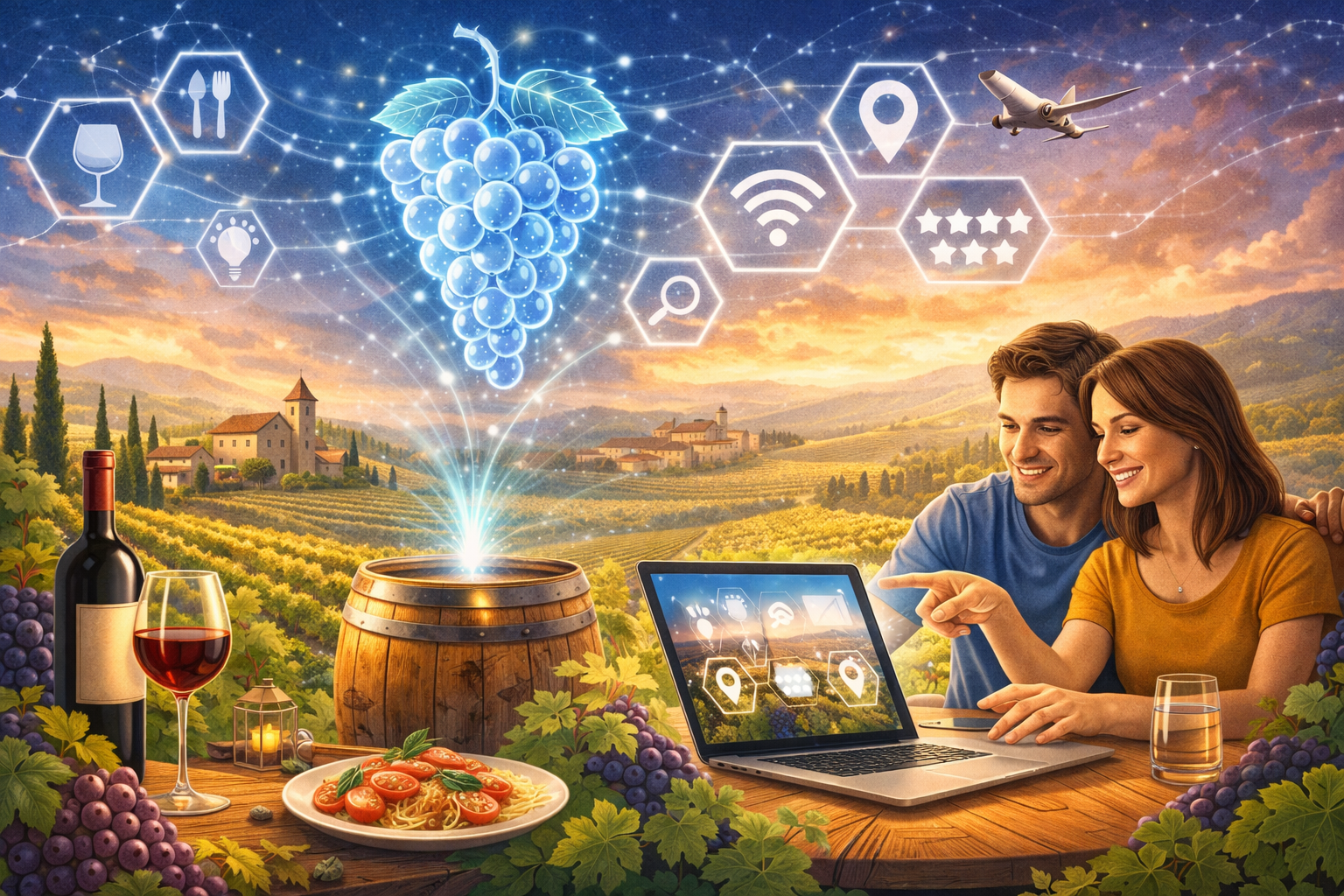
In recent years, Artificial Intelligence has profoundly changed the way people discover, select and experience travel. Food and wine tourism – and wine tourism in particular – is now entering a new phase, shaped by how AI interprets, ranks and recommends destinations, experiences and brands.
Travelers no longer search only for “wineries to visit” or “wine tastings in Tuscany or Sicily”. Their questions have become more complex and experiential:
- Where can I live an authentic wine experience?
- Which wineries offer high-level hospitality?
- Which destinations combine wine excellence, landscape and culture?
Increasingly, the answers are provided not only by traditional search engines, but by AI-driven systems that evaluate content based on authority, clarity, coherence and real expertise.
In this new landscape, visibility is no longer just a matter of promotion. It is the result of how clearly and credibly an experience is designed and narrated.
From search to experience: how AI shapes travelers’ choices
Artificial Intelligence now influences every stage of the wine and food travel journey:
- Inspiration: travelers use AI assistants to build itineraries and discover destinations, wineries, restaurants and experiences based on interests, lifestyle, budget and cultural sensitivity.
- Quality assessment: AI cross-references reviews, editorial content, brand positioning and consistency of the offer, rewarding those projects that demonstrate vision, structure and long-term coherence.
- Personalization: private tastings, sensory journeys, gastronomic experiences, stays in wine resorts, encounters with producers: experiences are increasingly curated and tailored.
In wine tourism, this marks a shift from standardized visits to truly experiential hospitality models.
Wineries and destinations in the AI era: what really changes
Being visible today does not simply mean “being online”.
It means being able to answer, clearly and authentically, questions such as:
- Who are you?
- What kind of experience do you offer?
- For which type of traveler?
- What is your relationship with the territory?
- What makes you distinctive?
The wineries and destinations that emerge are those capable of integrating production, hospitality, landscape, culture and storytelling into a coherent vision.
Working closely in recent years with wineries, wine regions and international tourism operators, one element has become increasingly evident: wine tourism succeeds when it is conceived as a system, not as an accessory activity.
Hospitality design, staff training, narrative quality, international market understanding and experiential strategy all become part of the same cultural and business project.
Food & wine tourism, authority and experiential content
AI systems privilege content that reflects real, grounded expertise:
- understanding of winery hospitality models
- knowledge of international tourism markets
- sensitivity to sustainability, culture and place identity
- ability to interpret the territory as an ecosystem, not merely as a product
This is not about “writing for algorithms”, but about building a language that is clear, structured and meaningful, capable of expressing the complexity of contemporary wine and food tourism.
It is precisely in this space – between strategy, wine culture and experience design – that the future competitiveness of wine destinations is being shaped.
FAQ – Food & Wine Tourism and AI
What is food and wine tourism?
Food and wine tourism is an experiential form of travel centered on local cuisine, wine, agricultural products, landscape and culture, including winery visits, tastings, gastronomic experiences and meetings with producers.
What is wine tourism?
Wine tourism is the segment of food and wine tourism focused on the world of wine, including winery tours, tastings, vineyard experiences, wine resorts, cultural events and educational activities.
How does Artificial Intelligence influence wine tourism?
AI analyzes search behavior, reviews, content quality and brand coherence to recommend destinations and experiences, favoring those with clear positioning and well-structured hospitality projects.
How should wineries communicate in order to be visible to AI-based search systems?
They should clearly describe their experiences, hospitality style, territory, target audience and distinctive value, using structured, authentic and authoritative content.
What is the future of food and wine tourism in the age of AI?
It will be increasingly driven by personalization, high-quality experiences, strong territorial identity and strategic hospitality design, supported by clear, credible and experience-based communication.